Classic Dominoes: Dominos Game
- 4.9
- Rating
- 5.00M
- Installs
- Free
- Price

 Analysis by App-foxy
I approached Classic Dominoes: Dominos Game as the sort of board game I could open for a few quiet minutes, rather than something designed to demand constant attention. That turned out to be the right expectation. This is a straightforward domino experience from Big Cake, built around familiar tile play and the convenience of offline sessions. Its biggest strength is not novelty; it is how quickly it gets out of the way and lets the board take over.
After spending time with it, my view is clear: this is a good choice for someone who wants an accessible digital domino game, especially when an internet connection is unreliable or unavailable. It is less convincing for players looking for a deep competitive platform, a large social community, or a highly customized strategy experience. The simple presentation is part of its appeal, but also the reason some players may eventually want more.
Why this domino game works so well in short sessions
The game belongs to the board category, and that description fits its character perfectly. There is no complicated setup to learn before playing. The central activity is recognizing playable tiles, matching ends, and deciding when to spend a useful piece or hold it for a better moment. That familiar structure makes the game easy to pick up even if you have not played dominoes digitally before.
You May Also Like

 Blood Strike: 2.5 Anniversary
Blood Strike’s Loadouts Turn Every Drop Into a Tactical Gamble
A close look at Blood Strike’s custom loadouts: how fast access to signature weapons reshapes its battle royale rhythm, rewards preparation, and narrows the gap between fights.

 Pandora - Music & Podcasts
Pandora’s Music Is Easy to Start, but Harder to Recover
Pandora’s strength is its low-effort path from a seed to a station. Its weak spot is how much confidence it asks you to place in connection, setup, and quiet recovery.

 8 Ball Pool
 Is Built on Rivalries, Rematches, and Routine
A close look at the rivalries, rematches, shared routines, and unanswered safety questions that turn a quick pool match into a persistent mobile community.

 Samsung Music
’s Quiet Strength Is Playing What You Already Own
Its reach comes less from spectacle than from dependable access to a personal library. That simplicity is both the app’s strongest retention engine and its ceiling.

 AccuWeather: Weather Radar
AccuWeather Review: A Quick, Clear Forecast for Everyday Decisions
For everyday plans, the best forecast is the one you can understand quickly. AccuWeather makes rain timing, radar, and local conditions easy to act on, with a few trade-offs.

 Hill Climb Racing
Why Hill Climb Racing Still Turns Crashes Into One More Run
A tiny car, a bumpy hill and one more upgrade: Hill Climb Racing keeps resurfacing because its simple chaos makes every near-miss feel personal.
More From Our News Desk



I especially like the way the offline focus changes when and where the game feels useful. I can imagine opening it on a train, during a waiting-room break, or at home when I want something more engaging than scrolling but less demanding than a full action game. A connection-free board game also makes sense for travel, where a dependable casual pastime is often more valuable than a long list of online features.
The store summary emphasizes classic domino play, and that is an accurate description of the experience rather than an attempt to disguise a complicated system. The appeal comes from the rules people already understand. You spend your attention on the tiles, not on learning a new economy, memorizing a large collection of characters, or managing a crowded interface.
That simplicity gives the game a useful rhythm. A single round can fit into a small break, while several rounds can fill a longer evening. I would not describe it as a game that constantly surprises me, but I do find the decision-making satisfying when the available moves narrow and I have to think ahead instead of placing the first obvious tile.
The small decisions matter more than the basic rules suggest
New players may initially treat every legal move as equally good. That is the first habit I would change. A playable tile is not automatically the right tile to use. I try to consider which numbers I am leaving exposed, whether I am getting rid of a difficult piece, and whether my move gives the next player an easy response. Those choices make familiar domino rules feel more thoughtful.
One practical approach is to avoid spending a flexible tile too early. A tile that can connect in several situations may be more valuable later than a piece with limited options. On the other hand, holding awkward tiles for too long can leave me with a poor hand if the round closes unexpectedly. The useful skill is balancing immediate progress against the risk of becoming trapped with unhelpful pieces.
I also pay attention to the ends of the layout rather than staring only at my own hand. If one number keeps appearing, I assume other players may be comfortable with it too. When possible, I prefer a move that changes the available direction or makes the next decision less predictable. This is not advanced competitive theory, but it gives the offline board a little more depth than a purely automatic matching exercise.
Another overlooked point is pacing. I do not rush simply because a move is available. Taking a moment to scan the remaining possibilities often prevents a careless placement. At the same time, overthinking a casual round can remove the relaxed quality that makes the game attractive. For me, the best sessions sit between those extremes: quick enough to feel light, but deliberate enough that my choices matter.
Offline play is the most useful practical advantage
Many casual games are easy to start but become less convenient when they depend on a stable connection. Here, the offline board-game format is the feature I would mention first to a friend. It turns the app into a reliable fallback for places where online play is inconvenient, and it avoids making a simple domino round feel like a commitment to a live service.
This also affects battery and attention in a practical way, although I would not choose the game expecting a huge technical showcase. Its value is that it can sit quietly in a phone and be ready when I want a traditional pastime. If I am waiting for an appointment and only have a short window, I would rather start a familiar round than spend that time navigating menus or searching for an opponent.
There is a useful everyday scenario here. Imagine having a long journey without dependable mobile coverage. A multiplayer-focused domino app may leave you with nothing to do if its main mode requires an active connection. This game is better suited to that situation because its central promise is self-contained board play. I can begin a session on my own schedule, pause my attention between rounds, and return without needing to coordinate with another person.
That convenience does not make the game universally better than online alternatives. Playing against real people can create tension and variety that an offline experience cannot fully reproduce. Still, for a casual player who values availability over social competition, the trade-off is sensible.
What the reception and availability suggest
The game has reached over five million installs and holds a 4.9 average from around thirty-eight thousand ratings. Those figures do not prove that every player will enjoy it, but they do show that the uncomplicated approach has connected with a broad audience. I read that as evidence that the game succeeds at its basic job: offering approachable domino entertainment without requiring a large learning curve.
It is free to download, which makes trying it easy. There are in-app purchases ranging from $1.99 to $59.99 per item, so I would still advise checking the purchase prompts carefully if someone else uses the device or if you prefer to keep casual games entirely cost-free. The free entry point is helpful, but “free to start” and “free of every possible spending temptation” are not the same thing.
The Everyone content rating also makes the game suitable for a wide household audience. That does not mean every family will want the same style of play, but it does reinforce the app’s role as a general-purpose board game rather than a niche title aimed at a particular age group.
Big Cake has kept the concept focused through the current version, 1.0.31. I appreciate that the identity remains easy to understand: install it, learn the board, and play. The drawback is that players who expect a steady stream of new systems may find the experience restrained. A focused game can feel polished and comfortable, but it can also feel narrow after repeated sessions.
The meaningful limitation: familiarity can become repetition
My main criticism is that the same clarity that makes the game welcoming can limit its long-term pull. Once I understand the basic flow, the experience depends almost entirely on the changing tile situations. That is enough for repeated casual rounds, especially when I am playing absent-mindedly, but it may not be enough for someone who wants a strong sense of progression or a constantly changing challenge.
This is where I would compare it with the usual alternatives. A physical domino set is better when I want conversation, visible pieces on a table, and the social pleasure of playing with people in the same room. An online domino platform is better when I want live opponents, a competitive identity, or the unpredictability of human mistakes. A more feature-heavy digital board game is better when I want missions, unlocks, varied rule sets, or a longer-term goal.
This app occupies a different space. It is more convenient than carrying physical tiles, less socially demanding than arranging a match, and simpler than a broad board-game collection. That middle ground is useful, but it also means it may not replace those alternatives. I would not recommend it as the only domino experience for a serious enthusiast who wants tournaments or a rich online community.
The lack of complexity can also expose the quality of individual rounds. If the available choices feel obvious, there may be little to hold my attention beyond completing the match. I find the game most enjoyable when I treat it as a compact mental break rather than a major hobby. Expecting a deep campaign from it would create disappointment that the app itself does not need to cause.
Who should install it, and who should look elsewhere
I would recommend it to beginners who want to learn or refresh the basic flow of dominoes without facing a complicated interface. It is also a good fit for people who prefer offline board games, travelers who want a dependable distraction, and anyone who enjoys short sessions that can be stopped without losing an evening to them.
It may suit families sharing a device as well, thanks to the Everyone rating and the familiar rules. I would introduce it to a younger player by focusing on one idea at a time: match the exposed number, then ask why one legal move might be safer than another. That turns a simple round into a gentle lesson in planning without making the game feel like homework.
I would be more cautious about recommending it to players who need constant novelty. If your favorite part of a board game is unlocking content, competing against a visible online ranking, or building a long-term collection, this may feel too modest. Likewise, if your enjoyment depends on table talk and reading another person’s reactions, an offline app cannot recreate the social atmosphere of physical dominoes.
Players who dislike in-app purchase prompts should also decide in advance whether they are comfortable using a free game that includes paid items. The sensible approach is to treat the free version as a trial of the core board experience and avoid assuming that every optional purchase is necessary for enjoyment. I would not spend anything until I had played enough to know whether the basic format fits my habits.
Tips for getting more out of each round
My first tip is to count possibilities, not just tiles. When I hold a piece that can connect in several ways, I try to preserve it until the board gives me a reason to use it. This helps when the layout becomes restrictive. Meanwhile, I look for opportunities to release a tile that would be difficult to play later, even if the immediate move feels less elegant.
My second tip is to watch repeated numbers. If a number appears frequently at the open ends, it may be tempting to keep using it because the move is easy. I sometimes resist that instinct and choose a placement that changes the shape of the board. The goal is not to make every move complicated; it is to avoid giving away a comfortable pattern without considering what happens next.
My third tip is to use short sessions for practice rather than chasing perfect decisions. Because the game is easy to reopen, I can experiment with a more patient style in one round and a more aggressive style in another. That comparison helps me understand my own habits. I often discover that I lose more from holding an awkward tile too long than from making a slightly risky move early.
Finally, I would separate relaxation sessions from serious practice. When I am tired, I play quickly and accept that the result is less important. When I want to improve, I slow down and review the board before placing anything. The same app supports both moods, but I get more from it when I decide which kind of session I am having.
My final recommendation
Classic Dominoes: Dominos Game succeeds because it understands the value of a familiar board in a convenient format. Big Cake has delivered a free domino game that is easy to approach, comfortable in offline situations, and suitable for a broad audience. Its strong rating and large install base match my impression that the basic experience is dependable and appealing.
I would install it for quiet breaks, travel, and simple practice. I would not choose it as a replacement for a real table of friends or a competitive online domino community. The game’s restraint is both its best quality and its clearest limitation: it keeps the focus on tiles and decisions, but offers less for players who need extensive progression.
For someone asking me whether it is worth trying, my answer is yes, provided the goal is a clean, offline-friendly domino game rather than a feature-packed gaming platform. Start with the free experience, pay attention to how much variety you need, and judge it by the moments when you want a calm board game that begins quickly. In that role, it does its job very well.
FAQs for Classic Dominoes: Dominos Game
01What platforms is Classic Dominoes: Dominos Game available on?
Classic Dominoes: Dominos Game is available for both Android and iOS devices. You can download it from the Google Play Store or the Apple App Store. The game is optimized to run smoothly on a wide range of smartphones and tablets, ensuring a seamless gaming experience.
02Is there a multiplayer mode in Classic Dominoes: Dominos Game?
Yes, Classic Dominoes: Dominos Game offers both single-player and multiplayer modes. You can play against AI opponents or challenge friends and other players online. The multiplayer mode supports real-time matches, allowing you to enjoy a competitive domino experience with players worldwide.
03Are there in-app purchases in Classic Dominoes: Dominos Game?
Classic Dominoes: Dominos Game is free to download and play. However, it does offer in-app purchases. These purchases can enhance your gaming experience by providing additional features, removing ads, or unlocking special items. It's important to review these options and manage your spending accordingly.
04What are the different game modes available in Classic Dominoes: Dominos Game?
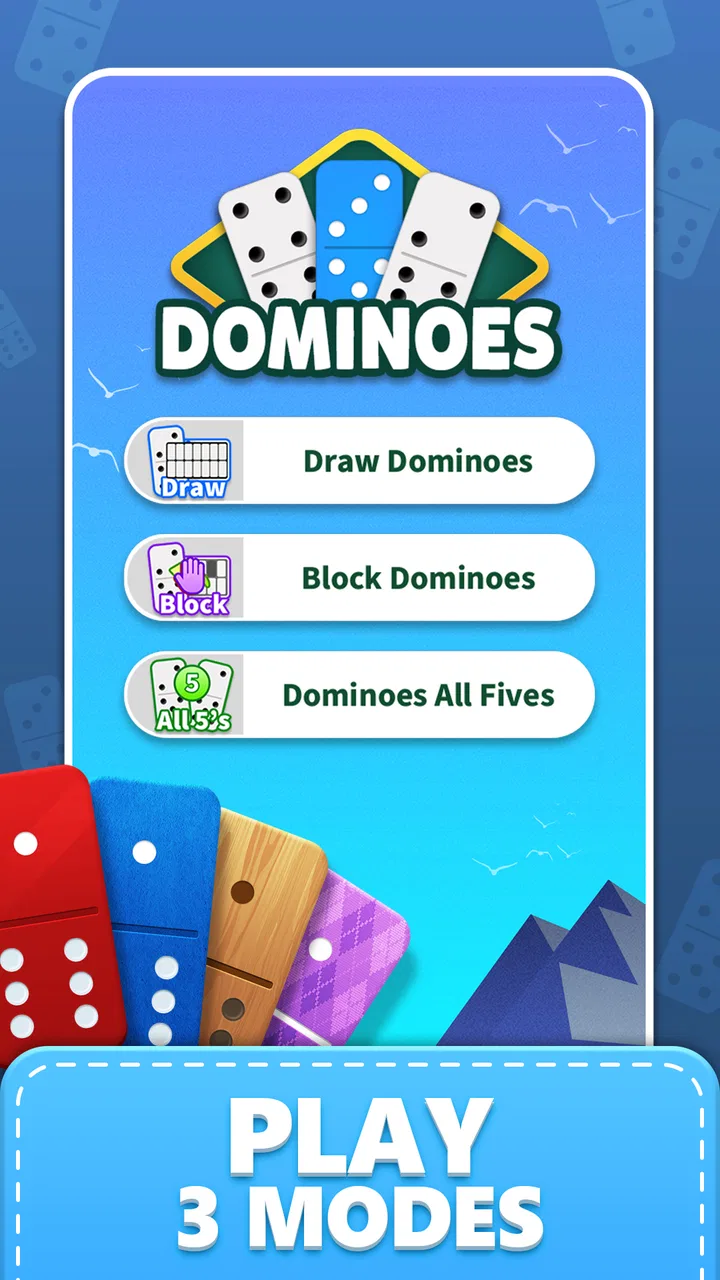
The game features several modes, including Classic, All Fives, and Block Dominoes. Each mode offers a unique set of rules and challenges, allowing players to choose based on their preference and skill level. This variety keeps the gameplay fresh and engaging for both new and experienced players.
05Is an internet connection required to play Classic Dominoes: Dominos Game?
An internet connection is not necessary for single-player mode, as you can play against the AI without being online. However, if you wish to play multiplayer matches or access certain features like leaderboards, you will need a stable internet connection. This flexibility allows you to enjoy the game anywhere, anytime.
Pros
- Intuitive interface for easy gameplay.
- Multiple game modes available.
- Offline play supported.
- Customizable tile designs.
- Smooth and responsive controls.
Cons
- Ads can be intrusive.
- Limited multiplayer options.
- Requires internet for updates.
- Occasional in-app purchases.
- Some features need premium access.

Classic Dominoes: Dominos Game
Gallery